Why we built Voya
Most fitness apps give you data. We wanted understanding. Here’s how that became a product.

Nacho Van Droogenbroeck · Founder of Voya
April 30, 2026
I lost 15 kilograms in 2025. I gained 4 of them back in February. I lost them again in March. I'm telling you this because the reason I'm building Voya is sitting inside that gap.
Where I started
I've been fighting obesity for 25 years, since I was 15. Nothing catastrophic on the health side, lucky me, but plenty of the small daily costs: clothes that weren't made for someone my size, never being fast enough or agile enough to enjoy a sport.
And the bullying. I'm not going to dress that up. Kids said the things kids say, and adults said the quieter, more careful version of the same things. Those leave marks. Marks that chase you into rooms decades later, the ones where you catch yourself shrinking before anyone has even looked at you. I'm 40 and I still feel them on bad days. Building Voya is, partly, the longest argument I've had with those marks.
A lot of it traced back to what was on the table. In a small town, healthy food was hard to find and expensive when you could. So you ate what was there. That was the start.
I cycled a lot as a kid. It wasn't enough, and it took me years to understand that activity without a balanced diet doesn't move the needle. I went to nutritionists who handed me lists of things to eat, avocado, peanut butter, ingredients I'd only ever seen on TV, never at the local grocery store. I'd follow the plans, lose weight, hit the first bump, gain it back. Frustrating doesn't begin to cover it.
What didn't work
Eventually I had the modern tooling. I had a Garmin watch. I had MyFitnessPal. I had Cronometer when MyFitnessPal got annoying. I had a personal trainer for two months. I had a smart scale that measured eight metrics nobody could explain to me.
My first MyFitnessPal weigh-in was August 11, 2012. The chart since then tells a story I've shown almost no one. Two big losses, all the way down to 102 kg. Two equally big regains, back up to 135. A 33 kg corridor I lived inside for over a decade.
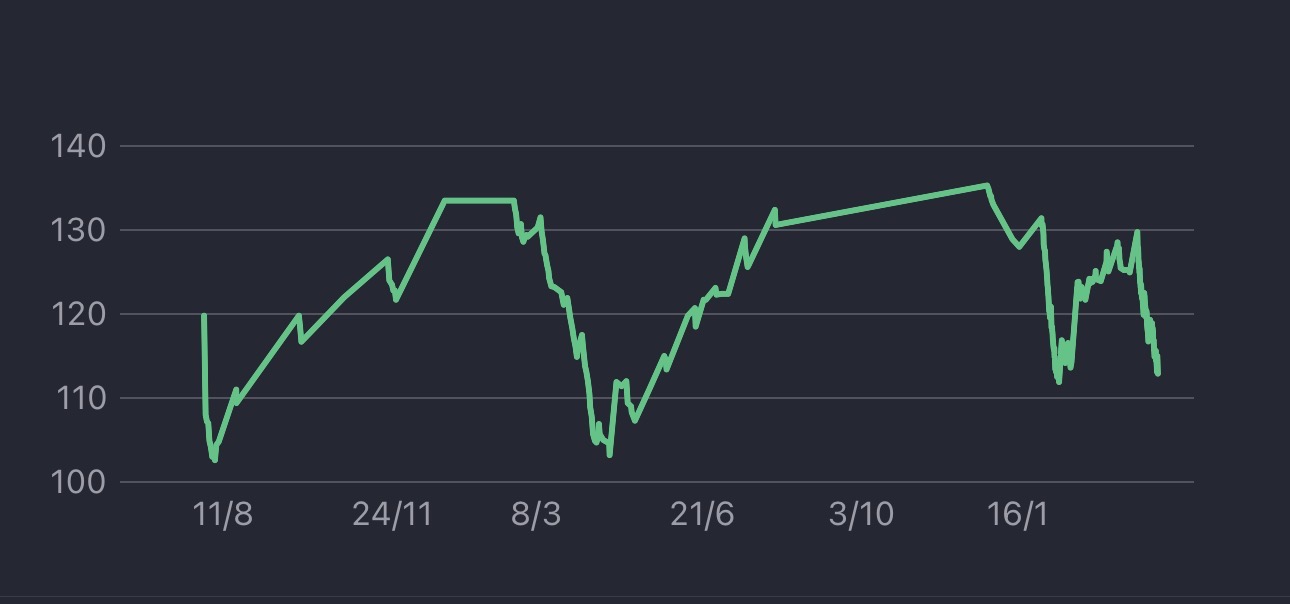
What I didn't have was a way to interpret any of it. The scale would jump 0.8 kg after a clean weekend and I'd panic. The HRV would crater for three days and I'd feel guilty. The trainer would say "trust the process" without ever showing me what the process was actually doing inside my body.
The pattern
I quit each of those tools, eventually. Not because I lacked discipline (I'd lost 15 kg, the discipline was clearly there) but because the data stopped making sense. And once data stops making sense, every clean day starts to feel pointless.
This, I now believe, is the failure mode of every health app. It's not a UX problem. It's not a feature problem. It's an interpretation problem.
What changed
The shift came when I started dumping my Garmin export, my food log, and my weight chart into an AI and asking it to read them like a coach would. Not "tell me what to eat", but "explain what's happening". That reframing changed everything.
For every gram of carbs I eat, my body retains around three grams of water. After an intense run, my muscles hold water while they repair. So when the scale jumps 2 kg the morning after pizza, that's not 2 kg of fat. It's water and glycogen, and it's gone in two days.
Without that context I would rage-quit. Why bother? I can't even enjoy a pizza? Then I'd spiral, gain weight back, and start over months later. With the context, the scale becomes information instead of a verdict.
That was the unlock. The data had been there for years. What I'd been missing was someone, or something, that could read it with me.
What I wanted
I wanted a coach who could look at my morning numbers and say:
"Yeah, scale is up 0.8 kg. You slept 5 hours, sodium was high yesterday, and you trained legs the day before. That's water and glycogen, not fat. Eat normally today, sleep tonight, expect a drop Friday."
That's it. That's the whole product.
The other thing I wanted was a goal structure that didn't break me. A 40 kg target is paralyzing. So I borrowed sprints from my software work: short, target-based milestones, no deadlines. I started at 130 kg. The first sprint wasn't "get to 90", it was "lose 5 kg, then plan the next one". You finish a sprint when you cross the milestone, not when a clock runs out.
I started January 12, 2026. As I write this on April 30, the scale reads 110. Twenty kilograms in three and a half months, four sprints of five kilos each. That's not a stunt: it's a sustainable pace built on understanding what my body is doing day to day. The next 20 kg are coming the same way.
What Voya is
Voya is that coach. It's not a tracker (those exist). It's not a chatbot (those exist). It's a coach that has read every paper on body composition, reads your wearable data when you ask, remembers everything you've ever told it, and explains what's happening in your body in plain English, day by day.
Sprint-based goals, milestone by milestone. A check-in whenever you're ready, morning, evening, after a workout. Garmin sync as the data layer Voya reads every morning. No app-switching. No forms. Just a conversation.
Voya can track your food, sleep, and activity, but only because the advice gets better when it's grounded in real data. Voya is not a planner. It won't hand you a 12-week template and hope you make it. The advice comes from your data, not from hope.
Who Voya is for
Voya is for people who already track and still feel lost. If you've worn a Garmin for a year, logged thousands of meals into MyFitnessPal, and still can't tell the difference between a bad week and a hard week, you're who I built this for.
If you're already wearing a Garmin and logging food but the numbers don't tell you anything useful, that's the gap Voya fills. The sprint structure is forgiving by design, and the daily explanations turn every weigh-in into a lesson instead of a judgment.
What Voya isn't is a 12-week template that promises a number by a date. If that's what you want, there are apps that do it well. Voya is the slower, sturdier path: one milestone at a time, built on knowing your own body.
A note on pace: 20 kg in three and a half months was my body, my starting weight, my circumstances. Your sprints will look like your sprints, not mine. Voya's job is sustainable progress on your physiology. And if you're managing a clinical condition, an eating disorder history, or anything that needs a doctor or dietitian, Voya is a complement to that care, not a substitute for it.
What's next
Voya is live at voya.fit. 14-day free trial. $19.99/month billed annually, or $29.99/month if you'd rather go month to month.
If you're on your fourth weight-loss app this year, I'd love for this to be the one that sticks. Not for vanity. For health. For finally being in on the conversation about your own body.
Data, in plain English, every single day. That's the whole pitch.
You got this.
Nacho